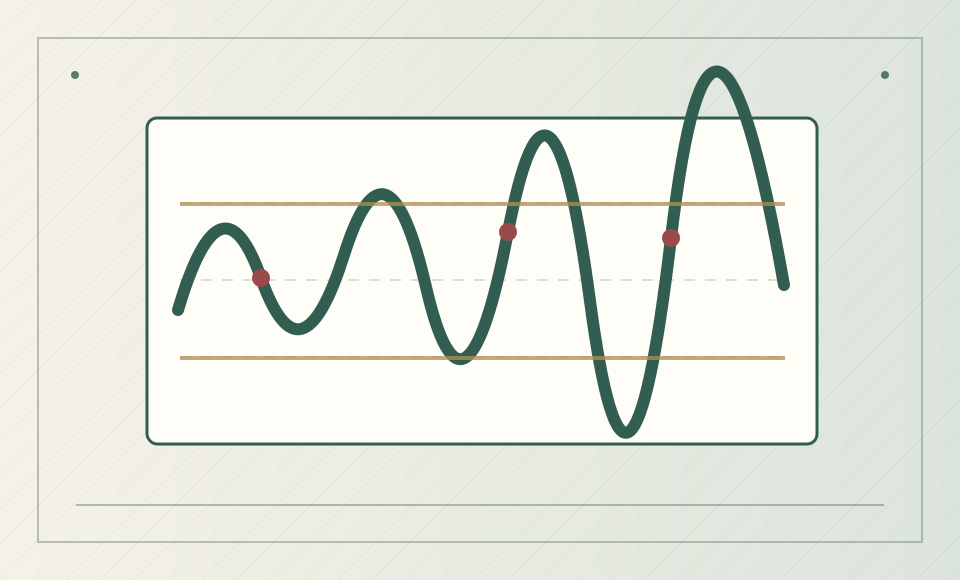
Moving averages smooth noisy price data, making persistent direction easier to see while necessarily reacting after the underlying move has begun.
The underlying mechanism
A simple moving average weights every observation in its window equally; an exponential moving average weights recent observations more heavily. Crossovers can be used as signals, but shorter windows are more sensitive to whipsaws.
A simple moving average gives equal weight to a fixed set of recent prices; an exponential moving average typically emphasizes more recent observations. Both smooth past data and therefore necessarily react after underlying prices change. They do not independently reveal economic value.
How to evaluate it in practice
Choose a timeframe based on the decision to be made. Compare whether a moving average is used as a trend descriptor, risk filter or entry trigger; those are distinct hypotheses. Calculate the impact of realistic costs and the number of trades.
A crossover can highlight a sustained shift in a trend, but whether it helps depends on the market regime, lookback, time frame and execution cost. Distinguish a mathematically defined signal from the performance of a strategy that acts on it.
Common mistakes and limits
Optimizing a lookback period on the same historical sample used to judge it creates overfitting. A beautiful chart of selected winning crossovers says little about prospective performance.
Repeated crossovers in sideways markets can produce numerous losing trades before costs are even counted. Order types and slippage add a separate execution layer; see the SEC’s order guide.
An exercise for careful readers
Compare two smoothing lengths on a predeclared sample, count both false signals and delayed exits, and reserve a separate period for a blind check.
Choose two average lengths and freeze them before testing later data. Compare turnover, drawdown and net results against a hold-only or simpler rule. A historical moving-average line is not a live trading recommendation.
Continue your research
Explore the related topic hub, the risk warning and our editorial standards for additional context. External primary-source references appear below this article.